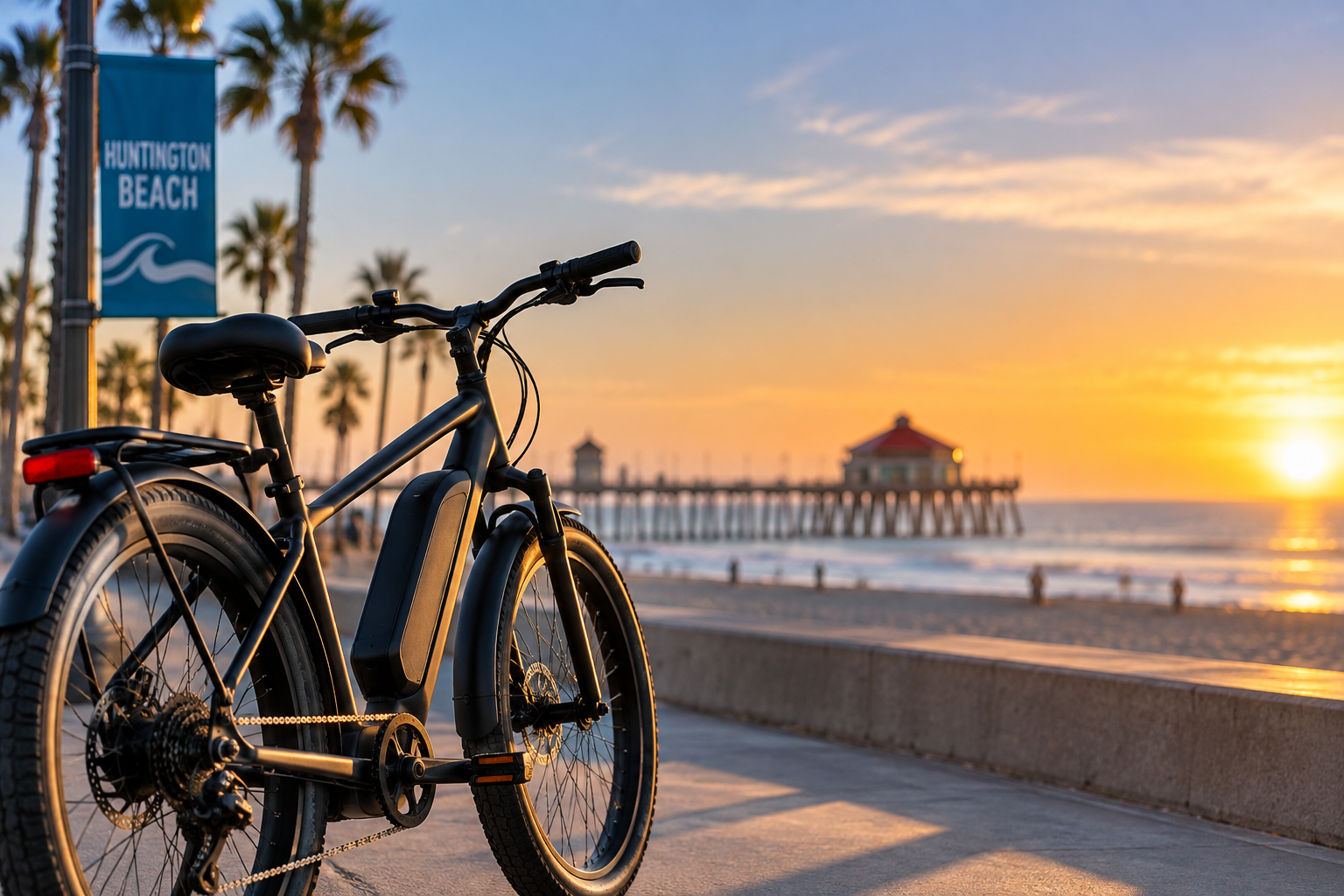
Yes, but what you get charged with depends entirely on how your bike is classified. A legal e-bike falls under Vehicle Code 21200.5, where the fine is capped at $250 and an adult’s license is not at risk. A modified or overpowered bike can be treated as a motor vehicle and charged as a full DUI under Vehicle Code 23152.
Same ride home from Main Street, two completely different cases. The difference comes down to a sticker on the frame and what the motor can physically do.
Is an e-bike a motor vehicle in California?
A legal e-bike is not a motor vehicle. Vehicle Code 312.5 defines an electric bicycle as a bicycle with fully operable pedals and a motor not physically capable of exceeding 750 watts. There are three classes:
Class 1 assists only while you pedal and stops at 20 mph. Class 2 has a throttle and stops at 20 mph. Class 3 assists only while you pedal, stops at 28 mph, and must have a speedometer.
If your bike fits one of those classes, the law treats it as a bicycle. No license, no registration, no insurance, and no full DUI.
Senate Bill 1271 changed the math on January 1, 2025. The definition now turns on what the motor is capable of doing, not how the bike is currently set up. A bike that can be made to exceed those limits is not an e-bike at all, and plenty were reclassified overnight without their owners knowing.
Once a device falls outside that definition, the Legislature’s own analysis says it becomes a motorized bicycle, a motorcycle, or a motor driven cycle. All three require an M1 or M2 license. All three are motor vehicles. That is the doorway to 23152.
The three ways an impaired riding case can be charged
| Issue | Bicycle or legal e-bike | Motorized scooter | Motor vehicle |
| Statute | VC 21200.5 | VC 21221.5 | VC 23152 |
| Maximum fine | $250 | $250 | Fines plus penalty assessments, often thousands |
| Jail exposure | None | None | Up to six months on a first offense |
| License suspension, age 21 and over | None | None | Yes, through the court and the DMV |
| Impact on a rider under 21 | One year suspension or delay under VC 13202.5 | Not referenced in the statute | One year suspension |
| Required chemical test | No. The rider may request one | No. The rider may request one | Yes, under implied consent |
| DMV hearing within 10 days | No | No | Yes |
What happens if the bike has been modified?
This is where most of these cases are won or lost.
California has spent three legislative sessions closing the gap on modified bikes. Assembly Bill 1774 banned selling devices that raise an e-bike’s speed, and a 2025 follow up extended that to phone apps after an Orange County manufacturer was named in committee. Vehicle Code 24016 makes modifying a bike’s speed capability illegal on its own.
As of January 1, 2026, Assembly Bill 875 lets officers impound a noncompliant high power device, or a Class 3 e-bike ridden by anyone under 16, for at least 48 hours. Getting it back can require storage fees and proof of a completed safety course.
So if a teenager bought a bike secondhand, or a parent changed a speed setting, the classification question is already live before anyone has had a drink.
Can a minor get a DUI on an e-bike?
This is the part that turns a ticket into a family emergency.
Vehicle Code 21200.5 ends with a sentence most people never read: violations are subject to Section 13202.5. Under that statute, a rider at least 13 and under 21 faces a one year suspension of their driving privilege. If they have no license yet, the court orders the DMV to delay issuing one for a year past the date they would otherwise become eligible.
A 15 year old cited on a beach cruiser can lose the first year of driving before ever sitting behind a wheel. The statute says the court shall suspend, not may. Adults over 21 face no license consequence at all for the same offense.
That asymmetry is why a case that looks minor on paper deserves a real defense. Our page on underage DUI covers how these cases work, and diversion is often available on a first offense if someone asks.
Do you have to take a breath test on an e-bike?
No, and this catches officers out as often as riders.
California’s implied consent law applies to people who drive a motor vehicle. Vehicle Code 21200.5 works the other way around: it gives an arrested rider the right to request a blood, breath, or urine test. That is a right you hold, not an obligation you owe.
Field sobriety tests are voluntary too, which matters more here than in a car case. Without a required chemical test, the evidence is often nothing but the officer’s description of how you looked and rode. Our post on field sobriety tests in California and our page on the tests themselves explain why that evidence is weaker than it sounds.
Were you even on a highway?
Vehicle Code 21200.5 only applies to riding a bicycle upon a highway, meaning a public road open to vehicle traffic. Whether that covers a separated beach path or a boardwalk is a real question, and in a city where much of the riding happens on the path rather than the street, it is not an academic one.
How Huntington Beach is enforcing this
Huntington Beach is one of the most heavily enforced e-bike cities in the state. Police recorded 72 e-bike crashes in 2022 and 147 in 2024, and Children’s Hospital of Orange County reports youth micromobility trauma up more than 1,500 percent since 2019.
One operation in May 2026 along the beach path, boardwalk, parks, and school zones produced 105 contacts, 32 e-bike citations, an impound, and 29 referrals to the department’s rider training program.
The city also amended Chapter 10.84 of its municipal code so officers can issue civil or criminal citations for unsafe riding, including on private property open to the public. A civil citation under the city code is a different animal from a Vehicle Code charge, and the two get confused constantly.
Cases from Huntington Beach arrests are generally filed at the West Justice Center in Westminster. Parker Law Center is on Beach Boulevard here in town and handles DUI cases throughout Orange County.
Frequently Asked Questions
Does an e-bike DUI suspend your license in California?
For a rider 21 or over on a legal e-bike, no. A conviction under Vehicle Code 21200.5 carries a fine of up to $250, no license suspension, and no DMV hearing. For a rider between 13 and 20, the court must suspend or delay driving privileges for one year under Vehicle Code 13202.5. If the bike is classified as a motor vehicle instead, the full consequences of a standard DUI apply.
What if the rider is under 21?
A conviction under Vehicle Code 21200.5 is expressly subject to Vehicle Code 13202.5, which requires a one year suspension for anyone at least 13 and under 21. Riders without a license yet face a one year delay in eligibility. This applies even though the underlying offense carries a $250 maximum fine.
Can you get a DUI on a rented electric scooter?
A shared scooter falls under Vehicle Code 21221.5, which caps the fine at $250 and, like the bicycle statute, lets the rider request a chemical test rather than requiring one. Prosecutors have tried charging scooter riders under the full DUI statute instead, and defense attorneys have pushed those cases back to the $250 provision.
Is riding an e-bike under the influence a misdemeanor?
Yes. Vehicle Code 40000.13 states that a violation of 21200.5 is a misdemeanor and not an infraction. The only penalty is the fine, but it is still a criminal conviction that shows up on a background check.
Talk to a DUI attorney before you pay the fine
The instinct with a $250 ticket is to pay it and move on. That is usually the wrong call. For a rider under 21 it costs a year of driving. For anyone it creates a misdemeanor record. And if the bike is being called a motor vehicle, the exposure is nothing like $250.
Kellee Parker Harris has handled DUI cases exclusively since 2006 and has represented well over a thousand clients at DMV hearings and in courtrooms across Southern California.
If you or your child was cited on an e-bike in Huntington Beach, it costs nothing to find out how the bike is actually classified. Call Parker Law Center at (800) 805-8804 or request a free case evaluation.
This article provides general information about California law and is not legal advice. E-bike classification law changed in 2025 and again in 2026 and continues to develop. Speak with a qualified attorney about your situation.